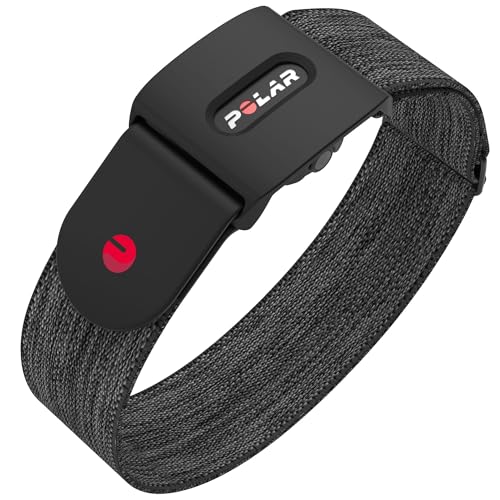
The Polar Verity Sense is the strongest wrist/armband pick: six-LED optical sensing that rivals chest-strap accuracy, paired with 30-hour battery life and 600 hours of onboard storage. If you specifically want running-specific data like ground contact time, the Garmin HRM-Pro Plus (a chest strap, worth knowing) adds that layer.
Check price on AmazonWrist and armband heart rate monitors have closed most of the accuracy gap with chest straps for steady-state activity, but that gap reopens during intervals and rapid heart rate swings, which is why a couple of chest-strap options are still worth knowing about here even on a roundup focused on wrist wear.
We compared optical sensor quality, battery life, and how consistently owners report accuracy holding up specifically during the moments it matters most: sprint intervals, heavy sets, sudden pace changes, since a monitor that’s accurate at rest but lags during exactly those moments isn’t giving you data you can actually train off of.
How we rank
We compared and ranked these devices based on published scientific accuracy studies, owner reviews, and expert analysis of sensor technology and battery life. See our method.
Quick picks
| Best for | Product | Who it suits |
|---|---|---|
| Best Overall | Polar Verity Sense | Runners, cyclists, and gym-goers seeking a reliable armband monitor |
| Best for Runners | Garmin HRM-Pro Plus | Runners wanting advanced running dynamics and dual connectivity |
| Best for Gym | Scosche Rhythm24 | Strength trainers and HIIT enthusiasts who need durable waterproof monitor |
| Best Value | Wahoo TICKR FIT | Budget-conscious athletes wanting dual Bluetooth and ANT+ |
| Best for Accuracy | Polar H10 | Anyone who wants clinical-grade heart rate accuracy |
| Best Smartwatch | Apple Watch Series 9 | iPhone users wanting a smartwatch with accurate heart rate tracking |
| Best for Recovery | Whoop 4.0 | Athletes focused on recovery tracking and strain management |
The picks, compared
Polar Verity Sense
A six-LED optical armband built to close the accuracy gap with chest straps as much as current sensor technology allows, with enough onboard memory to record 600 hours of data without a phone nearby.
What owners say: Consistency during interval workouts specifically is the standout praise, distinct from just general comfort claims most armbands get. There’s no on-device display for a real-time glance, and it runs bulkier than a watch-style monitor.
- Excellent accuracy across various activities
- Long 30-hour battery life
- Stores up to 600 hours of data without phone
- No built-in display for real-time feedback
- Bulky compared to watch-style monitors

Garmin HRM-Pro Plus
Worth including here despite being a chest strap rather than a wrist device: it captures running dynamics like cadence and ground contact time that no wrist-worn optical sensor can measure.
What owners say: Accuracy during interval training compared to wrist-based options is the specific, repeated praise, along with seamless Garmin ecosystem integration. It requires wearing a chest strap, a real trade-off for the added metrics.
- Provides running dynamics data
- Tracks swimming heart rate
- Long battery life (replaceable coin cell)
- Requires chest strap which some find uncomfortable
- More expensive than armband options

Scosche Rhythm24
An armband built specifically for gym and strength training use, with genuine IP68 waterproofing that goes beyond splash resistance into actual swim-safe territory.
What owners say: Staying securely in place during lifting and burpees, rather than shifting like some armbands do, is the specific praise from strength-training owners. The companion app runs clunky, and the band feels bulky on smaller arms.
- IP68 waterproof for swimming
- Secure armband for gym movements
- 24-hour battery life
- App interface can be clunky
- Slightly bulky on smaller arms
Wahoo TICKR FIT
An affordable optical armband with dual Bluetooth and ANT+ connectivity, aimed at people who want broad device compatibility without paying premium prices.
What owners say: Wide app compatibility, particularly with Zwift and Peloton, paired with a long 30-hour battery are the recurring praise. Accuracy can dip specifically during outdoor runs where wrist motion interferes with the optical reading.
- Affordable with strong feature set
- Dual Bluetooth and ANT+ connectivity
- Long 30-hour battery life
- Accuracy can dip during outdoor runs with wrist motion
- No onboard memory for workout storage
Polar H10
Included here as the accuracy reference point despite being a chest strap: this is what researchers and other devices get benchmarked against, not a wrist product.
What owners say: Reviewers consistently use this specific device as their benchmark for testing the accuracy of other wrist monitors, which says something about its reputation. It only stores one session on-device and skips advanced running metrics entirely.
- Reference-grade heart rate accuracy
- Onboard memory for 1 workout
- Long battery life (400 hours)
- Chest strap design may be inconvenient for some
- No running dynamics or advanced metrics

Apple Watch Series 9
A full smartwatch rather than a dedicated monitor, included for iPhone owners who want solid heart rate accuracy bundled with ECG, blood oxygen, and the broader Apple ecosystem.
What owners say: Consistency for daily runs and general gym sessions is the recurring praise, alongside the broader health-tracking feature set. Occasional lag during genuine interval training is a specific, repeated complaint, and battery life tops out around 18 hours.
- Excellent smartwatch features and app ecosystem
- ECG and blood oxygen monitoring
- Good optical heart rate for steady-state exercise
- Battery life limited to 18 hours
- Higher price than dedicated monitors

Whoop 4.0
A screenless wrist strap built around recovery and strain analysis rather than a real-time heart rate readout, a genuinely different use case than the workout-focused picks here.
What owners say: The daily recovery score specifically helping owners adjust training intensity is the recurring praise. The required monthly subscription is worth confirming you’re comfortable with, since there’s no functionality without it.
- Excellent recovery and strain analytics
- Comfortable for 24/7 wear
- Long 5-day battery life
- Requires monthly subscription for full features
- No display for real-time HR readout
How to choose
- Accuracy and Sensor Technology. Optical sensors use LEDs to detect blood flow. Look for models with multiple LEDs (e.g., 6 in Polar Verity Sense) for better accuracy during motion. Chest straps with electrodes are generally more accurate for interval training.
- Comfort and Fit. For wrist monitors, consider the band material and adjustability. Flexible silicone or fabric straps often feel better during long sessions. Ensure the sensor sits snugly against the skin without sliding.
- Battery Life and Charging. Dedicated armbands often last 24-30 hours on a charge, while smartwatches like Apple Watch offer 18-36 hours. Replaceable coin cell batteries (e.g., Garmin HRM-Pro Plus) can last a year.
- Connectivity and Compatibility. Bluetooth and ANT+ allow pairing with fitness apps and devices. Ensure your monitor works with your preferred platforms (Zwift, Peloton, Strava). Dual connectivity adds flexibility.
- Special Features and Use Cases. Some monitors offer running dynamics, swimming tracking, or onboard memory. If you want recovery insights, consider Whoop 4.0. For advanced metrics, Garmin HRM-Pro Plus is ideal.
Frequently asked questions
Are wrist heart rate monitors as accurate as chest straps?
In general, chest straps are more accurate during high-intensity interval training or rapid changes in heart rate. However, modern optical wrist monitors like the Polar Verity Sense can be nearly as accurate during steady-state cardio and daily use.
Can I use a wrist heart rate monitor for swimming?
Yes, but check the water resistance rating. Many armband monitors like the Scosche Rhythm24 are IP68 rated for swimming. Some chest straps like the Garmin HRM-Pro Plus also support swimming, but they may need a special strap.
Do I need a subscription for any heart rate monitor?
Most armband and chest strap monitors do not require a subscription. The Whoop 4.0 is a notable exception, requiring a monthly membership for its analytics. Others, like Polar and Garmin devices, are free after purchase.
What is the best budget heart rate monitor for your wrist?
The Wahoo TICKR FIT offers excellent value with dual Bluetooth/ANT+ connectivity and a comfortable armband. It provides reliable accuracy for most users at a lower price point.
How long does the battery last on a wrist heart rate monitor?
Battery life varies. Armband monitors typically last 24-30 hours per charge. Chest straps with replaceable coin cells (like Polar H10) can last up to 400 hours. Smartwatches like the Apple Watch need daily charging.
Can I connect a wrist heart rate monitor to my gym equipment?
Yes, most monitors use Bluetooth or ANT+ to connect to gym equipment like treadmills, exercise bikes, and rowing machines. Check compatibility with your specific equipment beforehand.
The verdict
The Polar Verity Sense is the best true wrist/armband pick for most people who train at real intensity. If running-specific metrics matter enough to accept a chest strap, the Garmin HRM-Pro Plus is worth it, and the Polar H10 remains the accuracy gold standard if precision trumps convenience entirely.