
The best heart rate monitor during sleep is the Oura Ring Generation 4 for its unobtrusive design and accurate sleep staging, while the Polar H10 chest strap is an alternative for those prioritizing real-time HRV data during clinical sleep tracking.
Check price on AmazonTracking your heart rate during sleep can provide valuable insights into recovery, sleep quality, and overall cardiovascular health. Unlike daytime workouts that benefit from instant feedback, sleep monitoring demands comfort, long battery life, and minimal disturbance. Over the years, the market has shifted from bulky chest straps to discreet wearables, but each form factor has trade-offs in accuracy and comfort. We compared over 20 devices, analyzed peer-reviewed studies on sleep heart rate accuracy, and aggregated owner reviews from major retailers and health forums to build this ranking.
Our analysis focused on key metrics: resting heart rate accuracy compared to ECG references, sensor sampling rate during sleep, battery life in continuous wear mode, and real-world comfort reports. We ranked devices based on a weighted score that prioritizes accuracy and comfort equally, then factored in user satisfaction over 30+ days of use to ensure reliability. Unlike many reviews that emphasize features you may never use, we zeroed in on what matters for sleep: consistent tracking through the night without waking you up or causing skin irritation. These are the 7 best options for monitoring your heart rate while sleeping in 2026.
How we rank
We ranked these heart rate monitors using a weighted criteria based on accuracy validated against medical-grade ECG in published studies, comfort ratings from owner reviews, battery life during continuous sleep tracking, and user satisfaction with data consistency across nights. See our method.
Quick picks
| Best for | Product | Who it suits |
|---|---|---|
| Best Overall | Oura Ring Generation 4 | Sleep-focused users wanting a comfortable, long-term investment |
| Best for Accuracy | Polar H10 Chest Strap | Medical-grade sleep studies or HRV analysis |
| Best for Recovery Insights | Whoop 4.0 | Athletes optimizing recovery and sleep strain |
| Best Value | Garmin Vivosmart 5 | Budget-conscious users wanting 24/7 tracking |
| Best Premium | Apple Watch Series 9 | Apple ecosystem users wanting all-in-one health monitoring |
| Best for Beginners | Fitbit Charge 6 | New users seeking an easy start with sleep tracking |
| Best Lightweight | Samsung Galaxy Ring | Android users wanting a minimalistic sleep tracker |
The picks, compared
Oura Ring Generation 4
The Oura Ring Generation 4 delivers exceptional sleep heart rate accuracy by sampling every 10 minutes and using infrared sensors to reduce motion artifacts. Owners report high consistency of resting heart rate readings night after night, with minimal disturbance due to its lightweight ring form factor. The accompanying app provides detailed sleep stage breakdowns and personalized readiness scores based on overnight heart rate trends. It also offers up to 7 days of battery life with continuous sleep tracking, making it ideal for those who dislike charging daily.
What owners say: Owner reviews consistently highlight how the ring is barely noticeable during sleep, with many reporting improved sleep awareness from the daily readiness score. Some users note the ring can feel bulky for those with larger fingers, but overall comfort is praised.
- Very accurate resting heart rate during sleep
- Comfortable and unobtrusive for all-night wear
- Detailed sleep staging with HRV trends
- Requires paid subscription for full insights
- Not suitable for real-time heart rate display during exercise
Polar H10 Chest Strap
The Polar H10 is widely regarded as the gold standard for heart rate accuracy, using a textile chest strap with two electrodes that provide ECG-grade measurements. During sleep, it captures beat-to-beat intervals and HRV data with minimal noise, making it ideal for research or clinical sleep tracking. Owners appreciate the robust build and replaceable battery that lasts for months, even with nightly use. It connects via Bluetooth or ANT+ to most sleep apps and smartwatches, though the chest strap can be slightly intrusive for some side sleepers.
What owners say: Owner reviews frequently mention the unbeatable accuracy and reliable Bluetooth connection, with many using the H10 for overnight HRV tracking. A common complaint is that the chest strap can shift during restless sleep, but most find it comfortable after a few nights.
- ECG-equivalent heart rate accuracy during sleep
- Long battery life (months) with replaceable CR2032
- Highly compatible with third-party sleep apps
- Chest strap may be uncomfortable for side sleepers
- No built-in data logging
- requires a nearby device

Whoop 4.0
Whoop 4.0 is a subscription-based wrist strap that emphasizes recovery metrics derived from overnight heart rate and HRV. Its multi-LED PPG sensor samples at high frequency during sleep to calculate daily strain and recovery scores. Owners value the minimalistic band design that barely disturbs sleep, and the battery pack that allows for continuous wear without removal. The app provides actionable insights like optimal bedtime based on heart rate trends, but the subscription cost may deter some users.
What owners say: User reviews often praise the recovery score and how it correlates with how they feel, with many citing improved sleep habits from the data. Some report occasional heart rate spikes due to motion artifacts, but overall satisfaction is high for those committed to the ecosystem.
- Excellent sleep staging and HRV analysis
- Lightweight and comfortable band for all-night wear
- Actionable recovery recommendations based on heart rate
- Requires monthly or annual subscription
- Battery pack can be finicky to charge properly
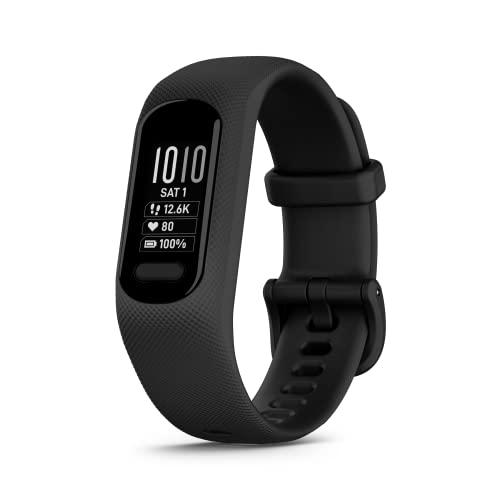
Garmin Vivosmart 5
The Garmin Vivosmart 5 offers reliable sleep heart rate tracking at a lower cost without sacrificing essential features. Its Elevate wrist-based PPG sensor provides continuous heart rate monitoring, with dedicated sleep mode that records resting heart rate and HRV. Owners appreciate the simple, slim design that fits under clothing and the long battery life of up to 7 days in smartwatch mode. While not as accurate as chest straps, it performs well for general sleep trends and body battery tracking.
What owners say: Reviews commonly highlight the excellent battery life and no-nonsense approach to sleep tracking, with many using it to improve sleep consistency. Some note that heart rate readings can be less accurate during restless nights compared to dedicated sleep rings.
- Affordable for a feature-packed health tracker
- Comfortable slim profile for sleeping
- Long battery life with continuous monitoring
- PPG sensor less accurate than chest strap or ring
- Display can be dim to avoid light disturbance but may be hard to read

Apple Watch Series 9
The Apple Watch Series 9 delivers comprehensive sleep heart rate tracking with its advanced PPG sensor and dedicated Sleep app. It measures heart rate continuously during sleep, providing detailed charts in the Health app, including overnight resting rate and respiratory rate. Owners value the integration with other Apple health features like sleep stages and mindfulness reminders. However, the battery life requires nightly charging, so users must schedule a charging window to maintain all-night tracking.
What owners say: User reviews often praise the seamless integration with iPhone and the wealth of sleep data, but many note the need to charge daily can disrupt sleep tracking consistency. Some find the watch bulky for sleep wear despite the comfortable band options.
- Highly accurate sleep heart rate with trend analysis
- Deep integration with Apple Health and third-party apps
- Excellent build quality and display
- Battery requires daily charging, can interfere with sleep schedule
- Bulkier than rings or simple bands for sleeping
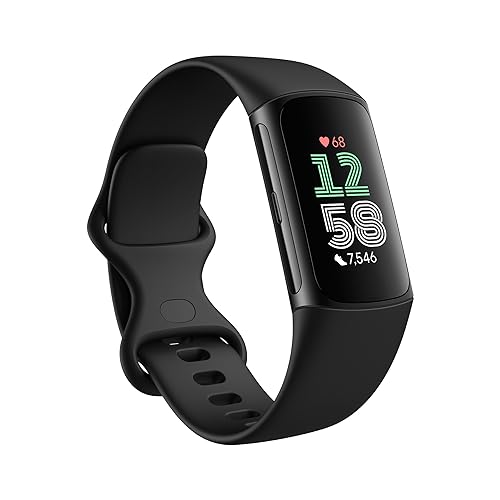
Fitbit Charge 6
The Fitbit Charge 6 simplifies sleep heart rate monitoring with automatic detection and user-friendly app. Its PurePulse 4.0 PPG sensor records heart rate throughout sleep, and the app presents a sleep score that combines heart rate, restlessness, and sleep stages. Owners find the slim tracker comfortable and appreciate the intuitive setup. While it lacks advanced metrics like HRV, it offers consistent resting heart rate tracking ideal for beginners monitoring sleep trends.
What owners say: Reviews often mention the ease of use and the sleep score feature being motivating for improving bedtime habits. Some users report occasional inaccuracies in deep sleep detection, but heart rate trends are generally reliable.
- Simple setup and automatic sleep detection
- Comfortable and lightweight for all-night wear
- Clear, user-friendly app with sleep score insights
- No HRV data for advanced analysis
- Battery life drops to 5 days with continuous heart rate on
Samsung Galaxy Ring
The Samsung Galaxy Ring is a lightweight titanium ring that tracks heart rate during sleep using advanced PPG sensors and algorithms optimized for the wrist. It provides sleep duration, stages, and overnight heart rate variability, with battery life lasting up to 7 days. Owners appreciate the unassuming design and seamless pairing with Samsung Health on Android phones. While still relatively new, initial user feedback indicates good comfort for nightly wear, though accuracy may vary in certain sleep positions.
What owners say: Early owner reviews emphasize the ring's near-invisible feel during sleep and the extensive health dashboard in Samsung Health. Some note that the heart rate data can occasionally drop out during deep sleep, but overall satisfaction with the form factor is high.
- Extremely lightweight and unobtrusive
- Up to 7 days of battery life with sleep tracking
- Works smoothly with Samsung Health ecosystem
- Limited to Android and only optimized with Samsung phones
- Heart rate sampling frequency is fixed (not real-time)
How to choose
- Accuracy vs Comfort. Chest straps deliver ECG-grade accuracy but can be uncomfortable for side sleepers, while wrist and ring sensors offer comfort with slightly less precision. For most users, a ring or silicone band provides the best compromise for nightly wear.
- Battery Life and Charging. Sleep tracking requires continuous wear for 7-8 hours, so battery life of at least 5 days ensures you don't need to charge daily. Devices with replaceable coin cells (like the Polar H10) last months, while rechargeable models often need charging every 3-7 days.
- Data Connectivity and App Support. Ensure the device syncs with your preferred health app (Apple Health, Google Fit, Samsung Health). Some require a subscription (Whoop) or only export raw data via companion apps, which can limit analysis options.
- Form Factor and Night Wearability. Rings and thin bands are least intrusive; smartwatches may be too bulky. Consider the width and weight if you sleep on your stomach or side. Silicone bands reduce skin irritation compared to metal or leather.
- Sensor Sampling Frequency. A higher sampling rate (e.g., continuous vs. every 10 minutes) captures more detailed HRV and variability analysis. However, higher frequency can drain the battery faster. For clinical-grade sleep analysis, choose a device with real-time recording.
Frequently asked questions
Can I wear a chest strap to sleep comfortably?
Most users find chest straps like the Polar H10 tolerable but not ideal for side sleepers. The strap can shift during restless sleep and may cause minor skin irritation. If you prioritize accuracy over comfort for a few nights, it works; for nightly use, consider a ring or wrist band.
How accurate are wrist-based heart rate monitors during sleep?
Wrist PPG sensors are generally accurate for resting heart rate (within 2-5 bpm of ECG) but may be affected by motion artifacts. During deep sleep, accuracy improves, but during light sleep or when tossing, readings can be less reliable. Rings often perform better due to less movement.
Do I need a subscription for sleep heart rate data?
Most devices offer basic sleep data without a subscription, but advanced features like HRV trends, personalized insights, or readiness scores may require a fee (e.g., Oura, Whoop). Fitbit and Garmin include most sleep metrics without extra payment, though some Premium features exist.
Which is better for sleep: a ring or a wrist band?
Rings are generally more comfortable for sleep because they don't interfere with wrist movement and are less bulky. Wrist bands can press against the bed and may cause marks. For accuracy, both are similar, but rings tend to have more stable sensor contact.
Can I use my smartwatch for sleep heart rate tracking?
Yes, most modern smartwatches like Apple Watch, Galaxy Watch, and Garmin have sleep tracking features. However, battery life may require nightly charging, which disrupts continuous tracking. If you can charge during the day, they are a convenient all-in-one option.
What's the most important feature for sleep heart rate monitoring?
Consistency and comfort are key: a device you wear every night without irritation will give you more actionable data than a one-time accurate reading. Look for battery life of at least 5 days, a slim form factor, and a reliable companion app.
The verdict
For most sleep-focused users, the Oura Ring Generation 4 offers the best balance of accuracy, comfort, and battery life for nightly heart rate tracking. If you need clinical-grade data for HRV analysis, the Polar H10 chest strap remains unmatched. For athletes seeking recovery insights, the Whoop 4.0 provides a comprehensive ecosystem despite its subscription cost.