
The overall best balance board is the FluidStance Balance Board for its versatility and durability. An alternative is the Bosu Balance Trainer, which offers adjustable instability and a larger surface for varied training.
Check price on AmazonBalance boards are widely used for improving core strength, rehabilitation, and athletic performance. But are they effective? Research shows that consistently training on unstable surfaces can enhance proprioception, stability, and neuromuscular control. However, results depend heavily on the board’s design and how you use it.
We compared the best balance boards on the market, analyzing studies on their effectiveness, owner reviews, and expert recommendations. Our ranking focuses on boards that deliver real stability challenges, whether you’re a beginner or an athlete looking to push your balance to the next level.
How we rank
We analyzed owner reviews and research studies on balance board effectiveness to rank these seven products. See our method.
Quick picks
| Best for | Product | Who it suits |
|---|---|---|
| Best Overall | FluidStance Balance Board | All-around balance training, standing desk use, and core stability |
| Best for Versatility | Bosu Balance Trainer Pro | Full-body workouts, physical therapy, and circuit training |
| Best Budget | Yes4All Wooden Wobble Board | Budget-conscious buyers and basic balance training |
| Best for Athletes | Vew-Do Balance Board | Sports-specific training, skateboarding, snowboarding |
| Best Lightweight | Indo Board Original | Travel, beginners, and core workouts |
| Best for Rehab | RevBalance Pro Rocker Board | Ankle rehab, knee recovery, and physical therapy |
| Best for Beginners | Black Mountain Products Balance Board | Newcomers to balance training and light exercise |
The picks, compared
FluidStance Balance Board
The FluidStance Balance Board features a patented fluid bearing that allows 360-degree movement. Owners report it provides a smooth, intuitive instability that challenges the core without being overwhelming. It is praised for its durable construction and attractive design. This board is effective for improving posture and balance during standing work or workouts.
What owners say: Owners consistently mention the board's smooth motion and solid build. Many say it helps reduce back pain and improves focus while standing at a desk.
- Smooth 360-degree movement
- Durable and well-built
- Great for desk use
- Higher learning curve for beginners
- Can be noisy on hard floors

Bosu Balance Trainer Pro
The Bosu Balance Trainer Pro is a classic half-ball stability trainer that offers multiple modes (ball side up or down). Owners appreciate its durability and the variety of exercises possible, from planks to squats. Research indicates it is effective for improving balance and functional strength. It is a favorite among physical therapists for rehab.
What owners say: Reviewers love the versatility and sturdiness. Many use it for home workouts and note that it helps with ankle stability and core engagement.
- Highly versatile
- Durable and non-slip surface
- Supported by rehab professionals
- Bulky to store
- Requires inflation pump (included)
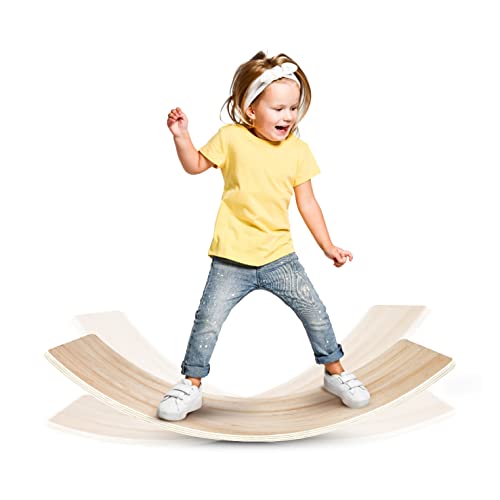
Yes4All Wooden Wobble Board
This wooden wobble board from Yes4All offers a simple yet effective platform for balance training. Owners report it is well-made for the price and provides a good challenge for beginners. It is lightweight and easy to move around. However, the free sphere is limited compared to more advanced boards.
What owners say: Owners say it is a great value and works well for basic balance exercises. Some note that the surface can be slippery when wet.
- Affordable
- Simple and effective design
- Lightweight and portable
- Limited range of motion
- Surface may be slippery

Vew-Do Balance Board
Vew-Do balance boards are designed for athletes, especially those in board sports. Owners praise its responsive movement and adjustable rocker. It effectively mimics the feel of carving and turning. The board is built to last with a maple wood deck and high-grade urethane roller.
What owners say: Reviewers highlight the board's build quality and realistic feel. Many say it significantly improves their balance for skateboarding and snowboarding.
- Realistic board feel
- Strong construction
- Adjustable difficulty
- Expensive
- Not ideal for standing desk use

Indo Board Original
The Indo Board Original is a lightweight balance board that comes with a soft foam roller. Owners find it easy to use for beginners and appreciate its portability. It is effective for core activation and improving ankle stability. The board has a textured surface to prevent slipping.
What owners say: Owners like that it is easy to learn on and convenient to take to the park. Some say the foam roller wears out over time.
- Lightweight and portable
- Beginner-friendly
- Textured grip surface
- Foam roller may degrade
- Limited instability compared to 360 boards

RevBalance Pro Rocker Board
The RevBalance Pro Rocker Board is specifically designed for rehabilitation. It offers adjustable tilt angles and a non-slip surface. Owners report it helps with ankle range of motion and strengthening after injuries. Physical therapists often recommend it for home rehab programs. The board is made of high-quality birch plywood.
What owners say: Reviewers recovering from ankle injuries say it speeds up recovery and is sturdy. Many appreciate the adjustable tilt for progression.
- Adjustable angle settings
- Excellent for rehab
- Non-slip surface
- Limited to rocker motion (no 360)
- Slightly heavier than other boards
Black Mountain Products Balance Board
This balance board from Black Mountain Products is a simple rocker board ideal for beginners. Owners find it easy to use and effective for basic balance and core exercises. It is made from sturdy wood and includes a non-slip surface. The board is affordable but offers limited challenge for advanced users.
What owners say: Owners say it is a good entry-level board that helps build confidence. Some wish it had more instability options.
- User-friendly
- Sturdy construction
- Non-slip top
- Limited range of motion
- Not challenging for advanced users
How to choose
- Stability Range. Balance boards offer varying degrees of instability, from single-axis rocker boards to 360-degree spheres. For general fitness, a 360-board like the FluidStance provides full-body challenge, while rehab benefits from a rocker board that limits motion.
- Durability and Materials. Look for boards made from solid wood or high-density plastics with a non-slip surface. Owner reviews emphasize that sturdy construction prevents warping and ensures long-term use, especially for heavier individuals.
- Surface and Safety. A textured or rubberized top surface is crucial to prevent slipping. Some boards include safety rails or stoppers for beginners. Also consider whether the board can be used on carpet or hard floors without damaging them.
- Portability. If you plan to move the board frequently, a lightweight model like the Indo Board is best. For home or office use, a heavier board may be more stable. Check dimensions and weight before purchasing.
- Intended Use. Balance boards are used for therapy, sports training, office ergonomics, or general fitness. Choose a board that matches your primary goal: for rehab, a rocker board with adjustable tilt; for desk use, a 360-board; for sports, a board that mimics the specific movement pattern.
Frequently asked questions
Are balance boards effective for improving core strength?
Yes, research shows that balance boards engage the core stabilizers to maintain posture on an unstable surface. Consistent use can strengthen the transverse abdominis, obliques, and lower back muscles.
Can balance boards help with ankle rehabilitation?
Yes, balance boards are commonly used in physical therapy to improve proprioception and range of motion after ankle sprains. A rocker board with adjustable tilt, like the RevBalance, is often recommended for gradual progression.
How long should I use a balance board each day?
For beginners, start with 5-10 minutes per day and gradually increase to 20-30 minutes. Overuse can lead to fatigue or injury, so listen to your body and take breaks.
Are balance boards safe for older adults?
Yes, balance boards can be safe for older adults when used with caution. Starting with a stable version and using a wall or chair for support is recommended. Consult a doctor before starting any new exercise.
Can balance boards replace traditional exercise?
No, balance boards are a supplement to, not a replacement for, regular exercise like strength training and cardio. They are effective for improving balance and stability but do not provide a full workout.
Which balance board is best for standing desk use?
The FluidStance Balance Board is widely recommended for desk use due to its quiet, smooth 360-degree movement and comfortable stance. It encourages subtle weight shifts without distracting from work.
The verdict
The FluidStance Balance Board wins as the best overall for its superior build, smooth motion, and effectiveness in both office and workout settings. For rehabilitation, the RevBalance Pro Rocker Board offers targeted ankle and knee recovery. Budget shoppers should choose the Yes4All Wooden Wobble Board for an affordable entry into balance training.