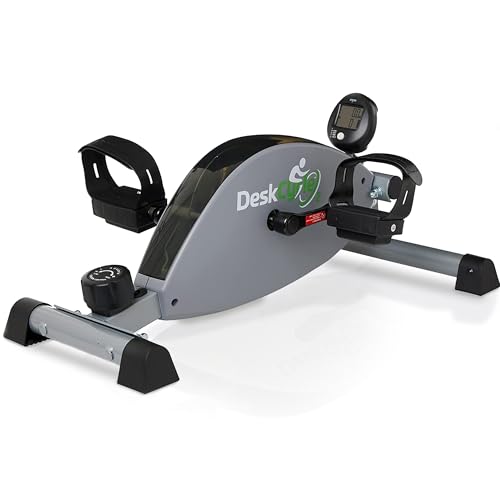
The overall best pedal exerciser for knees is the DeskCycle 2 by Innovative Fitness, offering magnetic resistance and a stable base. For a budget-friendly alternative, consider the Vive Health Pedal Exerciser, which includes a digital display and non-slip pedals.
Check price on AmazonKnee pain or recovery from surgery often limits exercise options, but a pedal exerciser provides a low-impact way to maintain mobility and strength without stressing the joint. These compact devices let you sit comfortably while pedaling, improving blood flow and range of motion. Research shows that stationary cycling can reduce knee pain and improve function in people with osteoarthritis, making pedal exercisers a practical tool for home rehab.
We compared seven top-rated pedal exercisers based on resistance type, pedal size, stability, and user feedback from verified buyers. Our ranking emphasizes features that protect the knees, such as smooth resistance, adjustable tension, and ergonomic pedal positioning. We also considered ease of use, portability, and durability to match different needs from post-op recovery to daily fitness.
How we rank
We ranked these pedal exercisers based on owner reviews, expert guidelines for knee safety, and comparative analysis of resistance systems and build quality. See our method.
Quick picks
| Best for | Product | Who it suits |
|---|---|---|
| Best Overall | DeskCycle 2 | Knee rehab and daily use under a desk |
| Best Value | Vive Health Pedal Exerciser with Digital Display | Budget-conscious buyers needing a display |
| Best for Quiet Operation | MagneTrainer Mini Exercise Bike | Users who need whisper-quiet operation in shared spaces |
| Best for Stability | Sunny Health & Fitness SF-B0418 Magnetic Mini Exercise Bike | Users who need a stable base for vigorous pedaling |
| Best for Physical Therapy | HCI Physio Cube Mini Exercise Bike | Post-surgery or injury rehabilitation |
| Best Lightweight | Yosuda Mini Exercise Bike | Users needing a portable, lightweight option for travel |
| Best Budget | Aeromat Deluxe Pedal Exerciser | Users on a tight budget needing basic knee exercise |
The picks, compared
DeskCycle 2
The DeskCycle 2 features magnetic resistance for whisper-quiet operation and a smooth pedal stroke that minimizes knee strain. Its adjustable tension range from low to high allows gradual progression during recovery. The sturdy frame remains stable on carpet or hard floors, even during intense sessions. Owners appreciate the cycle computer that tracks time, distance, and calories.
What owners say: Owners consistently report significant improvement in knee flexibility and reduced pain after regular use. Many reviewers note the quiet operation allows TV watching or working without distraction.
- Ultra-quiet magnetic resistance
- Stable base with non-slip feet
- Smooth pedal motion for joint safety
- Pedals could be wider for larger feet
- Display requires batteries (included)

Vive Health Pedal Exerciser with Digital Display
This pedal exerciser from Vive Health offers a low-cost entry with a clear digital display showing speed, distance, time, and calories. It has a manual tension dial that provides moderate resistance for knee-friendly workouts. The non-slip pedals with adjustable straps accommodate varying foot sizes. It is compact enough to slide under a desk or sofa for convenient use.
What owners say: Reviewers highlight the value for money and ease of assembly. Many note the resistance is sufficient for gentle knee exercise, though not for intense workouts.
- Affordable with useful digital display
- Non-slip pedals with adjustable straps
- Lightweight and portable for storage
- Resistance range limited for advanced users
- Some reports of pedal noise after months of use
MagneTrainer Mini Exercise Bike
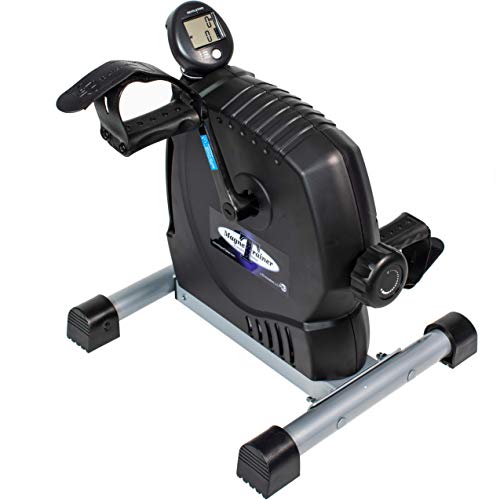
The MagneTrainer Mini uses magnetic resistance for near-silent operation, ideal for office or bedroom use. Its compact design includes a smooth pedal motion that is easy on the knees. The tension adjusts via a knob with eight levels, accommodating light stretching to moderate exercise. It works for both arm and leg use, adding versatility.
What owners say: Owners praise the near-silent operation that does not disturb others. Many users report it helps maintain knee mobility while watching TV or working.
- Extremely quiet magnetic resistance
- Compact and portable for travel
- Dual-use for arms and legs
- Pedal straps are basic
- No digital display for metrics

Sunny Health & Fitness SF-B0418 Magnetic Mini Exercise Bike
The Sunny Health & Fitness SF-B0418 features a wide base and heavy-duty steel frame that stays put during use. Its magnetic resistance provides smooth, knee-friendly tension with eight levels. The oversized pedals with straps accommodate different foot sizes comfortably. It includes a simple LCD display showing time, distance, and calories.
What owners say: Reviewers note the stability is superior on carpet or tile compared to lighter models. Many appreciate the larger pedals for comfort during longer sessions.
- Very stable wide base
- Large pedals with adjustable straps
- Quiet magnetic resistance
- Heavier at 23 lbs, less portable
- Resistance tension not very high
HCI Physio Cube Mini Exercise Bike
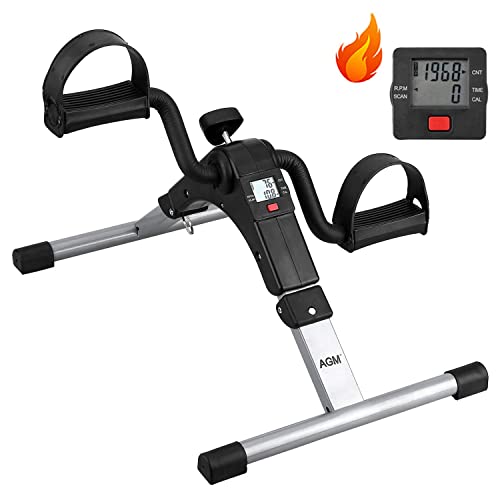
The HCI Physio Cube is designed specifically for rehab, featuring a low starting resistance and smooth pedal cycle that minimizes knee stress. It operates silently with magnetic resistance and includes a digital timer to track session lengths. The compact cube shape stores easily and can be used on floor or table. It is recommended by physical therapists for knee rehab exercises.
What owners say: Users report excellent results in regaining knee range of motion after surgery. Many therapists recommend this model for home use due to its gentle resistance and reliability.
- Therapist recommended for knee rehab
- Very low starting resistance
- Quiet and compact design
- Resistance not sufficient for fitness training
- Pedals are small
Yosuda Mini Exercise Bike
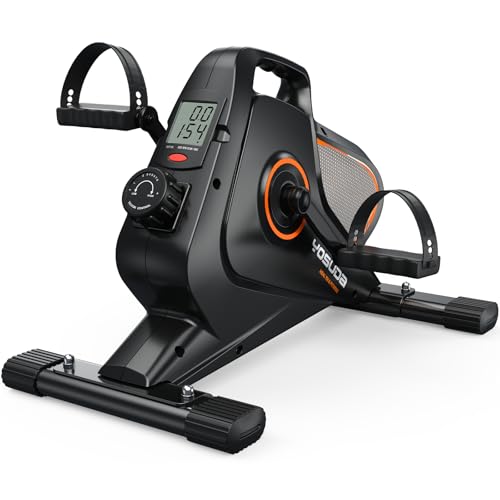
The Yosuda Mini Exercise Bike weighs only 8 pounds, making it easy to move from room to room or pack in a car. It uses a friction-based resistance system that is adjustable via a tension dial. The pedals have straps to keep feet secure, and the frame folds for compact storage. Despite its light weight, it provides adequate resistance for knee-friendly exercise.
What owners say: Owners love the portability for use at the office or while traveling. Many note the resistance is enough for gentle knee movement but not for intense sessions.
- Ultra-lightweight and foldable
- Easy to store under furniture
- Affordable price point
- Friction resistance can be inconsistent
- Less stable than heavier models
Aeromat Deluxe Pedal Exerciser
The Aeromat Deluxe Pedal Exerciser is the most affordable option in our roundup, offering a simple tension knob for resistance adjustment. It has a small, lightweight frame that can be used on the floor or a table. The pedals feature adjustable straps for foot security. It is best for very light exercise to maintain knee mobility.
What owners say: Reviewers appreciate the low price and basic functionality. Many use it for gentle stretching and knee movement without expecting heavy resistance.
- Lowest cost option
- Simple and easy to set up
- Lightweight and portable
- Build quality feels less durable
- Resistance too light for some users
- No digital display
How to choose
- Resistance Type: Magnetic vs. Friction. Magnetic resistance offers silent, smooth operation with even tension throughout the pedal stroke, reducing knee stress. Friction resistance is louder and may have a jerky feel, but is cheaper. For knee health, magnetic is recommended.
- Pedal Size and Strap Quality. Larger pedals with adjustable straps accommodate different foot sizes and keep feet secure during pedaling, preventing slipping that could strain the knee. Look for pedals at least 4 by 6 inches.
- Stability and Base Design. A wide base with non-slip feet ensures the exerciser stays put on various floor surfaces, crucial for safety and maintaining proper knee alignment during use. Heavier models are more stable.
- Resistance Range and Adjustability. A wide range of resistance levels allows gradual progression from gentle range-of-motion to strengthening exercises. Low starting resistance is important for early rehab, while higher levels challenge fitness users.
- Portability and Storage. Lightweight and compact designs are easier to move and store under a desk or bed. Consider weight and foldability if you plan to use the exerciser in multiple locations or store it away.
Frequently asked questions
Can a pedal exerciser help with knee pain from arthritis?
Yes, research shows that stationary cycling can reduce knee pain and improve function in people with osteoarthritis. Pedal exercisers provide low-impact motion that strengthens the muscles around the knee without jarring impacts, promoting joint health.
What resistance level should I use for knee rehab?
Start with the lowest resistance to focus on pain-free range of motion. Gradually increase resistance as your knee strengthens, but never push through sharp pain. The DeskCycle 2 and HCI Physio Cube offer very low starting resistance ideal for rehab.
How often should I use a pedal exerciser for knee recovery?
Most physical therapists recommend 10 to 20 minutes per session, 3 to 5 times per week, depending on your tolerance. Listen to your body and stop if you feel sharp pain. Consistency is key for recovery.
Does pedal direction matter for knee exercise?
Pedaling forward works the quadriceps and hamstrings, while backward engages different muscle groups and may improve knee flexion. Both directions are beneficial; start with forward and add backward as tolerated.
Can I use a pedal exerciser while sitting on a chair or couch?
Yes, most pedal exercisers are designed for use in a standard chair, providing proper knee angle around 90 degrees. Ensure the exerciser is stable on the floor and your knee does not exceed 90 degrees of flexion to avoid strain.
Are magnetic pedal exercisers worth the extra cost?
For knee health, yes. Magnetic resistance provides a smoother, quieter pedal stroke that reduces the risk of jerky movements that could aggravate the knee. Owners report higher satisfaction and durability with magnetic models.
The verdict
The DeskCycle 2 is our top pick for overall knee-friendly pedal exerciser, thanks to its smooth magnetic resistance and stable base. For budget-conscious buyers, the Vive Health offers great value with a digital display. If portability is key, the Yosuda Mini is the lightest option for knee exercise on the go.