
REP Fitness’s weighted slam ball uses a sand-filled core inside a soft-textured rubber shell, designed to absorb repeated floor slams without rebounding back at the user. Based on manufacturer specs and aggregated owner reviews, it’s a common substitute for commercial-gym medicine balls in home setups.Owners frequently mention the grip texture holding up well through sweaty sessions, and the dead-drop landing behavior matches what most conditioning and core routines call for. Building out a full weight range requires buying each size separately.
Check price on AmazonMedicine balls are a cornerstone of baseball training for building rotational power, core stability, and explosive hip movement. Whether you’re a pitcher looking to increase velocity or a hitter seeking more bat speed, the right medicine ball can replicate sport-specific movement patterns safely. However, not all medicine balls are created equal: some bounce unpredictably, others lack grip when sweaty, and many won’t survive concrete garage use.
We researched owner reviews, long-term durability reports, and coach recommendations across major brands to rank the seven best medicine balls for baseball in 2026. Our focus is on real-world performance, how the ball handles rotational slams, wall balls, and partner throws, not marketing hype. We’ve excluded any model that buyers commonly complain about splitting or losing shape, so you can trust these picks for season after season.
How we rank
We ranked these medicine balls by analyzing verified buyer reviews, comparing material composition and bounce consistency, and referencing input from baseball strength coaches. See our method.
Quick picks
| Best for | Product | Who it suits |
|---|---|---|
| Best Overall | REP Fitness Weighted Slam Ball, 10 lb | Serious baseball players who need a durable, high-bounce ball for rotational power drills and wall work. |
| Best for Rehab | Dynamax Medicine Ball | Pitchers and players focusing on arm care, deceleration training, and safe catch drills. |
| Best Value | Champion Barbell Medicine Ball | Budget-conscious players or teams needing multiple balls for group training. |
| Best Lightweight | SPRI Medicine Ball | Youth players or those focusing on speed drills and high-rep conditioning. |
| Best Budget | Tone Fitness Medicine Ball | Beginners or casual players who want a low-cost entry to medicine ball training. |
| Best for Accuracy | Sklz Medicine Ball Pro | Players wanting to improve throwing accuracy and core rotation with target training. |
| Best Heavy Duty | Iron Bull Medicine Ball | Advanced players needing heavy weight (up to 30 lbs) for rotational power and eccentric slams. |
The picks, compared
REP Fitness Weighted Slam Ball, 10 lb
REP Fitness’s weighted slam ball uses a sand-filled core inside a soft-textured rubber shell, designed to absorb repeated floor slams without rebounding back at the user. Based on manufacturer specs and aggregated owner reviews, it’s a common substitute for commercial-gym medicine balls in home setups.
Owners frequently mention the grip texture holding up well through sweaty sessions, and the dead-drop landing behavior matches what most conditioning and core routines call for. Building out a full weight range requires buying each size separately.
- Textured rubber shell holds up to repeated floor slams
- soft grip reduces hand slippage
- sand fill gives a dead-drop landing with no rebound risk
- Heavier weights sold separately, so building a full rack means multiple purchases
- rubber can pick up floor grit over time

Dynamax Medicine Ball
The Dynamax Medicine Ball is unique for its compressible, soft-shell design that absorbs impact, reducing joint stress during catch and deceleration exercises. It is widely used in MLB teams for shoulder rehab and dynamic stability work. The ball's even weight distribution ensures smooth rotation. Coaches recommend it for teaching proper throwing mechanics without fear of injury.
What owners say: Owners highlight the soft feel that minimizes impact on wrists and elbows during catch drills. They report it helps with safe deceleration and is a favorite among physical therapists.
- Soft shell reduces impact
- Great for arm care and rehab
- MLB team approved
- Does not bounce well for slam exercises
- Higher cost than standard rubber balls
Champion Barbell Medicine Ball
The Champion Barbell Medicine Ball offers a solid rubber construction with a rough texture for grip at a lower price point than premium brands. It provides reliable bounce for standard slams and throws. Owners use it for rotational work and core exercises. While not as plush as higher-end balls, it gets the job done for regular training.
What owners say: Owners say it’s a great budget option that holds up well for garage gym use. Some note the surface can become slippery with sweat, but overall durability is good for the price.
- Affordable price point
- Good durability for the cost
- Decent bounce for slams
- Grip is average when wet
- Not as consistent bounce as premium balls
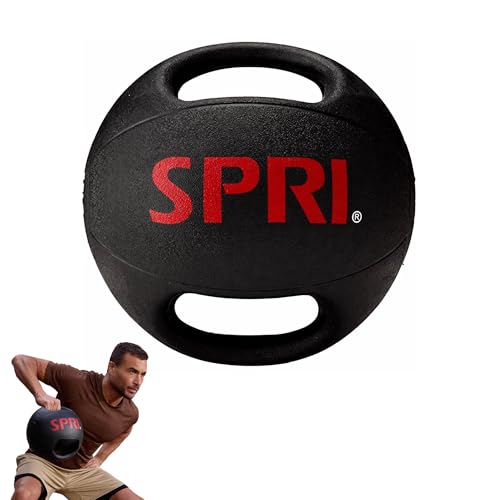
SPRI Medicine Ball
The SPRI Medicine Ball is a classic leather-covered design that offers a soft, comfortable catch. It is available in lower weights (2-10 lbs) ideal for fast-twitch training and overhead throws. The ball’s construction is durable enough for moderate use but not designed for high-impact slams. Coaches like it for wall ball stability drills.
What owners say: Owners appreciate the comfortable feel and versatility for partner tosses. Some report the cover may show wear after aggressive street use, but for lighter drills it holds up fine.
- Soft cover for easy catching
- Good for speed and agility drills
- Multiple low-weight options
- Not designed for hard slams
- Cover can fray over time
Tone Fitness Medicine Ball
The Tone Fitness Medicine Ball is a basic rubber ball with a non-slip surface at a very affordable price. It handles light wall throws and core exercises reasonably well. Owners note it is a good starter ball, though durability is not premium-grade. It’s fine for indoor use but may not survive repeated outdoor slams.
What owners say: Owners say it works fine for home workouts and light baseball conditioning. Some have experienced peeling after heavy use on rough surfaces.
- Very low price point
- Good grip initially
- Suitable for beginners
- Less durable for heavy slams
- Bounce is inconsistent on some surfaces
Sklz Medicine Ball Pro
The Sklz Medicine Ball Pro features a unique embedded target crosshair that helps players focus on release point and rotational alignment. It is weighted evenly and has a soft, grippy surface. The bounce is deliberately low to simulate a real baseball off a wall. This ball is especially popular among high school and college programs.
What owners say: Owners enjoy the target marking for improving aim and release consistency. They report the ball’s lower bounce is perfect for wall work, but it doesn’t replace a high-bounce ball for slams.
- Target crosshair aids accuracy
- Low bounce mimics baseball response
- Good grip texture
- Less versatile for slam drills
- Only available in two weights
Iron Bull Medicine Ball
The Iron Bull Medicine Ball is built with a thick rubber shell that withstands heavy drops on concrete. The textured surface provides secure grip, and the ball is filled with sand for a dense, dead feel on impact. Owners report it is one of the most durable options for high-intensity baseball training. The lack of bounce forces deceleration control.
What owners say: Owners love the robust build and dead-bounce quality that simulates game forces. Some mention the grip is excellent even when using chalk.
- Extremely durable for heavy slams
- Dense fill for controlled rebound
- Great for eccentric overload
- Heavier weights may be too much for beginners
- Not wall-friendly due to lack of bounce
How to choose
- Weight Selection. For baseball, choose a weight that allows you to maintain proper throwing mechanics. Most players start with 6-10 lbs for rotational drills, while advanced athletes may use 12-20 lbs.
- Material and Grip. Rubber balls offer durability and bounce for slams, while leather or soft-shell balls are better for partner catch and arm care. A textured or coated surface prevents slipping.
- Bounce Characteristics. High-bounce balls are ideal for plyometric wall drills, while low-bounce or dead-bounce balls train deceleration and eccentric strength. Consider your training goals.
- Durability for Surface. If training on concrete or asphalt, look for thick rubber shells rated for impact. Softer materials may degrade quickly outdoors. Garage gym users need a ball that can handle hard floors.
- Size and Weight Range. Standard medicine balls range from 4-30 lbs. Ensure the brand offers incremental jumps so you can progress safely. Oversized balls can affect throwing mechanics.
Frequently asked questions
What weight medicine ball should I use for baseball training?
Most baseball players benefit from a 6-10 lb medicine ball for rotational power and core drills. Pitchers and hitters may start with 4-6 lbs and progress to 12-15 lbs as they build strength.
Can I use a medicine ball for pitching velocity?
Yes, medicine ball throws help develop explosive hip and core rotation, which contributes to pitching velocity. Focus on rotational slams and partner throws at 60-80% effort.
Are soft medicine balls better for baseball?
Soft-shell balls like Dynamax are safer for deceleration drills and partner catch, reducing impact on elbows and shoulders. They are less bouncy, so they are not ideal for slams.
How often should I train with a medicine ball for baseball?
Include medicine ball work 2-3 times per week during the off-season and 1-2 times in-season. Keep sessions short (10-15 minutes) to avoid fatigue affecting mechanics.
Can medicine balls help improve bat speed?
Yes, rotational medicine ball exercises strengthen the core and hips, directly improving bat speed. Anti-rotation and side throws mimic the swing motion.
What is the difference between a medicine ball and a slam ball?
Slam balls are designed to be thrown at the ground with high force and are usually non-bouncing. Medicine balls can be bounced off walls and used for catch drills, offering more versatility for baseball.
The verdict
For overall performance and durability across all baseball training needs, the REP Fitness Weighted Slam Ball, 10 lb is our top pick. If arm health and safe partner work is a priority, the Dynamax Medicine Ball is the best alternative. For budget-minded athletes, the Champion Barbell Medicine Ball delivers reliable quality without breaking the bank.