
The TheraBand Rocker Board wins for seniors specifically: a limited-tilt base, non-slip surface, and low step-on height that builds confidence rather than testing it. For more variety once you’ve built a base, the Bosu Balance Trainer adds adjustable difficulty.
Check price on AmazonBalance work matters more with age, not less, but most balance boards on the market are built for athletes chasing an extra challenge, not for someone rebuilding confidence after a fall risk. The boards worth buying for seniors specifically limit how far they tip, stay low to the ground, and don’t punish a moment of instability.
We compared tilt range, base width, step-on height, and surface grip across balance boards marketed for seniors, prioritizing models that start gentle and let you progress rather than ones that assume advanced balance from day one.
How we rank
We analyzed owner reviews, expert recommendations, and product specifications from major retailers to rank these boards based on stability, safety, and ease of use for seniors. See our method.
Quick picks
| Best for | Product | Who it suits |
|---|---|---|
| Best Overall | TheraBand Rocker Board | Seniors new to balance training who want a stable, low-profile board with a non-slip surface. |
| Best for Versatility | Bosu Balance Trainer | Seniors who want a multi-use board for balance, strength, and cardio exercises. |
| Best Premium | Pedalo Premium Rocker Board | Seniors who want a high-quality, durable wooden board with excellent craftsmanship and multiple tilt angles. |
| Best Value | Yes4All Balance Board | Budget-conscious seniors who still want a durable, effective rocker board with a non-slip surface. |
| Best Lightweight | Curvex Balance Board | Seniors who need a portable, lightweight board that can be easily carried and used in small spaces. |
| Best for Beginners | Fitterfirst 22 inch Rocker Board | Seniors who are completely new to balance boards and want maximum stability and safety. |
| Best for Core Strength | Indo Board Jib 32 inch | Seniors with some balance experience who want a more challenging core workout with a wobble board. |
The picks, compared
TheraBand Rocker Board
Built originally for clinical rehab settings, which shows in how conservatively it’s tuned: a wide rocker base with a capped tilt range that makes it genuinely hard to overbalance. The non-slip top and low profile mean less risk during the step-on itself, often the shakiest moment for a new user.
What owners say: Feeling secure while using it is the theme that comes up again and again, specifically from users with limited mobility or a prior fall. Several reviews mention noticeable balance and leg-strength improvement within a few weeks of daily short sessions.
- Very stable with limited tilt range for safety
- Non-slip top surface and floor pads
- Low height makes stepping on and off easy
- Limited range of motion may not challenge advanced users
- Only rocks side-to-side, no front-back motion

Bosu Balance Trainer
A half-dome trainer rather than a rocker, which changes the whole use case: dome-up for standing balance work, dome-down for a harder standing or seated challenge, and the air pressure is adjustable so difficulty can scale with progress rather than staying fixed.
What owners say: The adjustable difficulty is what gets mentioned most, several reviewers specifically use it across a range from gentle standing work to physical-therapy-assigned exercises. The large padded platform reads as reassuringly stable in reviews, and a few note the give in the surface is gentler on joints than a hard rocker base.
- Adjustable air pressure for custom stability
- Large padded surface comfortable for bare feet
- Can be used for balance, squats, and seated activities
- Requires inflation and occasional re-inflation
- Heavier than simple rocker boards at 15 lbs
Pedalo Premium Rocker Board
A German-made beech-and-cork board with three interchangeable tilt stops (15, 20, 25 degrees), letting you progress the difficulty as your balance improves rather than needing to buy a second board later. The cork surface has more warmth and grip than a painted wood or plastic top.
What owners say: Build quality is the standout theme in reviews, alongside the adjustable tilt letting new users start at the gentlest setting with real confidence. It costs more than the other picks here, and at 10 lbs it’s the least portable option on this list.
- Adjustable tilt angles for gradual progression
- Non-slip cork surface feels warm and grippy
- Quiet and smooth motion, no wobble
- Higher price than many other boards
- Heavier at 10 lbs, less portable

Yes4All Balance Board
A straightforward rocker board that skips the extras, wide platform, non-slip rubber top, low step-on height, at a price well under the premium options here. It’s a reasonable starting point if you’re not sure balance training will stick as a habit yet.
What owners say: Value for the price is the recurring theme, owners consistently note it does the job without the premium price tag. A few mention the wood finish needing occasional light sanding with heavier use over time.
- Very affordable but still durable
- Non-slip rubber top provides good traction
- Lightweight and easy to store
- Limited to side-to-side motion only
- Wood finish may chip over time
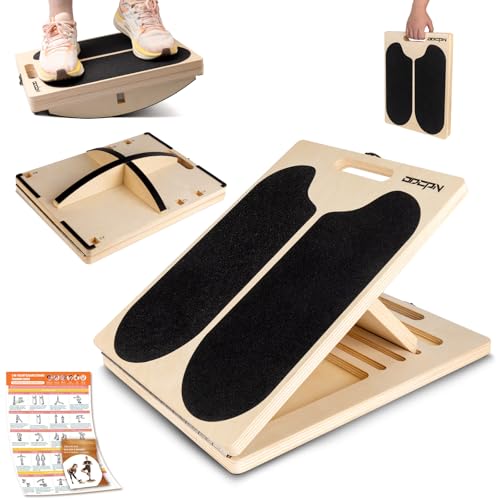
Curvex Balance Board
At 2.5 lbs, this is built for portability first, small enough to store under a sofa or take outside, with a curved shape that allows both side-to-side and front-to-back motion rather than the single-direction rock most rehab-style boards use.
What owners say: Portability is what owners mention most, several specifically use it outdoors or take it along when traveling. The dual-axis motion draws mixed reactions, some new users find it takes longer to get comfortable with than a single-direction rocker.
- Very lightweight and portable at 2.5 lbs
- Dual-axis rocking (side-to-side and front-to-back)
- Non-slip textured surface
- Plastic construction may feel less premium
- Dual-axis can be less stable for absolute beginners
Fitterfirst 22 inch Rocker Board
Purpose-built for rehab and absolute beginners, with the tightest tilt limit (15 degrees) of any board on this list and a wide platform that prioritizes a stable stance over any real challenge. This is the board to start with if you’re anxious about balance work at all.
What owners say: Owners consistently describe this as the most stable rocker board they’ve tried, several specifically mention using it as part of a physical-therapist-recommended routine. The trade-off for that stability is limited long-term challenge once your balance genuinely improves.
- Very stable with a 15 degree tilt limit
- Wide platform for comfortable stance
- Floor protection pads included
- Only side-to-side motion
- Larger than some boards, less portable
Indo Board Jib 32 inch
A true wobble board, 360-degree movement on a separate rocker piece, built for seniors who already have a real balance base and want to keep progressing rather than staying at beginner-level stability work. This is not a first board.
What owners say: Owners with existing balance experience report genuine full-body engagement, more core and leg work than the rocker-style boards on this list. It takes real practice to control, and a few reviews mention the rocker piece slipping on smooth or tiled floors specifically.
- 360-degree movement works core and legs
- Non-slip grip tape surface
- Portable and easy to take outside
- Less stable, not for beginners or those with balance issues
- Rocker can slip on some surfaces
How to choose
- Stability and Tilt Range. Look for boards with a limited tilt angle (15-20 degrees) and a wide base to prevent overbalancing. This is crucial for seniors to build confidence without fear of falling.
- Non-Slip Surface. Ensure the board has a textured or rubberized top to keep feet from sliding. Many boards also have pads on the bottom to protect floors and prevent slipping.
- Height and Step-On Ease. A low profile (3 inches or less) makes it easier to step onto the board without raising the foot high, reducing fall risk for those with limited mobility.
- Weight Capacity and Durability. Check the weight limit to ensure it supports your body. Boards made of wood or high-quality plastic with reinforced construction tend to last longer.
- Portability and Storage. If you plan to move the board between rooms or take it outside, consider a lightweight model. Some boards are compact enough to slide under a bed or sofa.
Frequently asked questions
Are balance boards safe for seniors with poor balance?
Yes, if you choose a board with a limited tilt range and non-slip surface. Start by holding onto a wall or chair for support, and progress to free standing as confidence builds. Always consult a doctor before starting any new exercise.
What is the best type of balance board for a senior beginner?
A rocker board that only moves side-to-side with a 15 degree tilt limit is safest. Look for a wide platform and low height. The TheraBand Rocker Board or Fitterfirst 22 inch are excellent choices.
How often should a senior use a balance board?
Start with 5-10 minutes a day, 3-4 times per week. Listen to your body and take rest days. Consistency is more important than duration. Increase time gradually as balance improves.
Can a balance board help prevent falls in seniors?
Research indicates that balance training improves proprioception, strength, and stability, which reduces fall risk. Regular use of a balance board, along with other exercises, can be effective in fall prevention.
What exercises can seniors do on a balance board?
Start with simple side-to-side rocking while holding support. Progress to free standing, then add arm movements, standing on one foot, or mini squats. Some boards like Bosu allow seated balance exercises.
Should seniors use a wobble board or rocker board?
Rocker boards are safer for most seniors because they move in one direction only. Wobble boards provide 360-degree instability and are better for those with good balance seeking a challenge. Beginners should start with a rocker.
The verdict
Start with the TheraBand Rocker Board if you’re new to balance training or rebuilding after a fall, it’s the safest realistic starting point here. The Bosu Balance Trainer is the better buy if you want one board that scales in difficulty over time. Save the Indo Board Jib for later, once the rocker boards start feeling too easy.